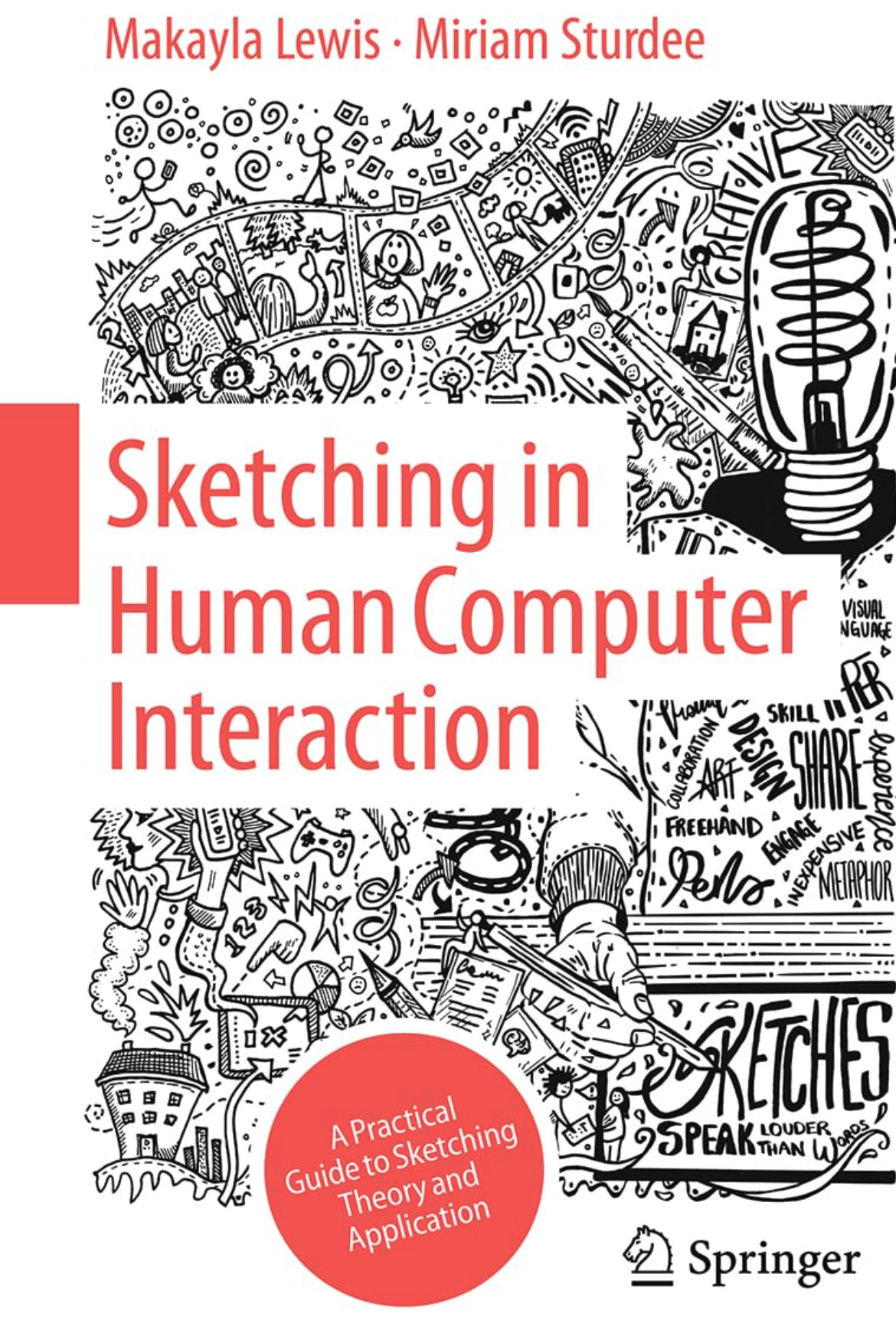
release of Textbook “Sketching in Human-Computer Interaction: A Practical Guide to Sketching Theory and Application”

I am excited to announce the release of Sketching in Human-Computer Interaction: A Practical Guide to Sketching Theory and Application, co-authored by Makayla Lewis (myself) and Miriam Sturdee.

We believe sketching is a universal activity that first appears when we play as children. Still, later, it is often overlooked as a useful skill in adult work – yet it can bring multiple benefits to research and practice in multiple domains. Specifically, Human-Computer Interaction (HCI) embraces interdisciplinary practices, and amongst those, sketching has proven to be a valuable addition to the skill set of researchers, practitioners, and educators in both academia and industry. Many individuals lack the confidence to take up pen and paper after years of non-practice, but it is possible to re-learn these lost skills, improve on them, and apply them practically to all areas of work and research. 

This book takes the reader on an active journey in sketching, from scribbles and playful interpretations to hands-on practical applications in storyboarding and, further, in examining qualitative analysis using sketching practice in HCI. Readers will learn a wide range of techniques and applied method sketching within HCI, guided by experienced authors, and join the larger community of those who employ (and enjoy) sketching in Human- for utilising sComputer Interaction.

Grab your copy now…

  • eBook: 978-3-031-50136-4 via Springer.
  • Softcover: 978-3-031-50135-7 via Springer.
  • Also available at Kindle and Amazon (UK, EU, and US), Waterstones (UK) and WHSmith (UK).
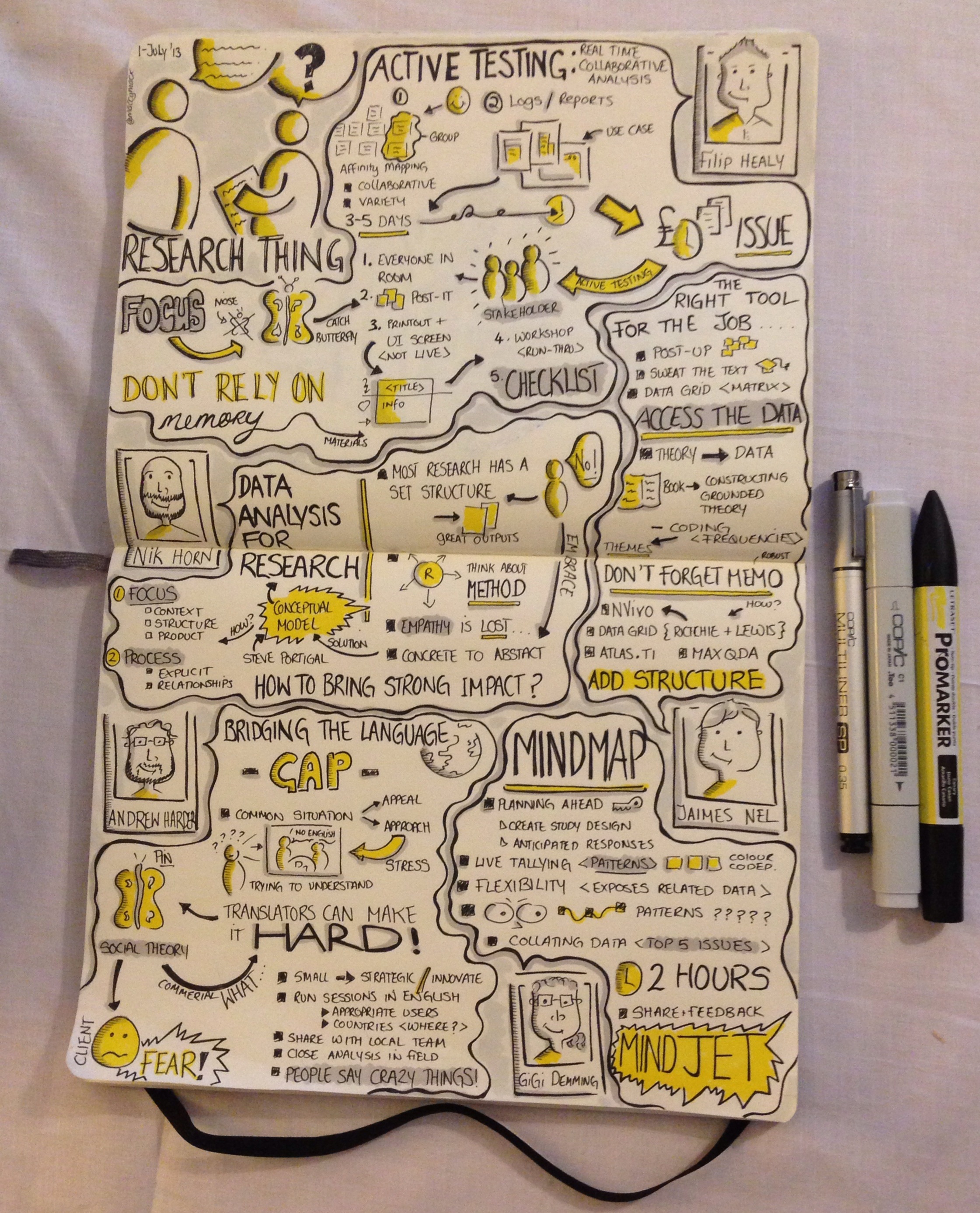
Sketchnotes: The Research Thing “Turning the mountain into a molehill – analysing research data”

Sketchnotes from Research Thing

Event information: http://www.meetup.com/researchthing/events/122907232/

  • “Done in a day: Collaborative real time analysis for agile teams” by Filip Healy
  • “Data analysis for Design Research: Approaches for modeling the problem/opportunity space” by Nik Horn
  • “The right tool for the job: Analysing messy data” by Jaimes Nel
  • “Breaking the Language Barrier: Understanding fieldwork when you don’t understand the fieldwork” by Andrew Harder
  • “Using mindmaps for quick analysis without compromising results” by GiGi Demming

©ALL RIGHTS RESERVED.

These photographs are presented here for viewing purposes ONLY. They are NOT royalty free images and may not be used for commercial or private use. Any such use of these images is strictly prohibited. Specifically, these images may not be copied, manipulated, be reproduced by any other means nor sold without prior written consent by the author.

CHI2013 write(sketch)-up

I recently attended CHI2013 (SIGCHI Conference on Human Factors in Computing Systems) and like a lot of attendees I decided to blog my experiences. I originally began a rather lengthy write-up that discussed the informative sessions I attended, the influential individuals I met and the key things I learnt. I was half-way through and said to myself:

“Makayla you’ve been sharing your sketchnotes throughout the conference why are you now writing?”

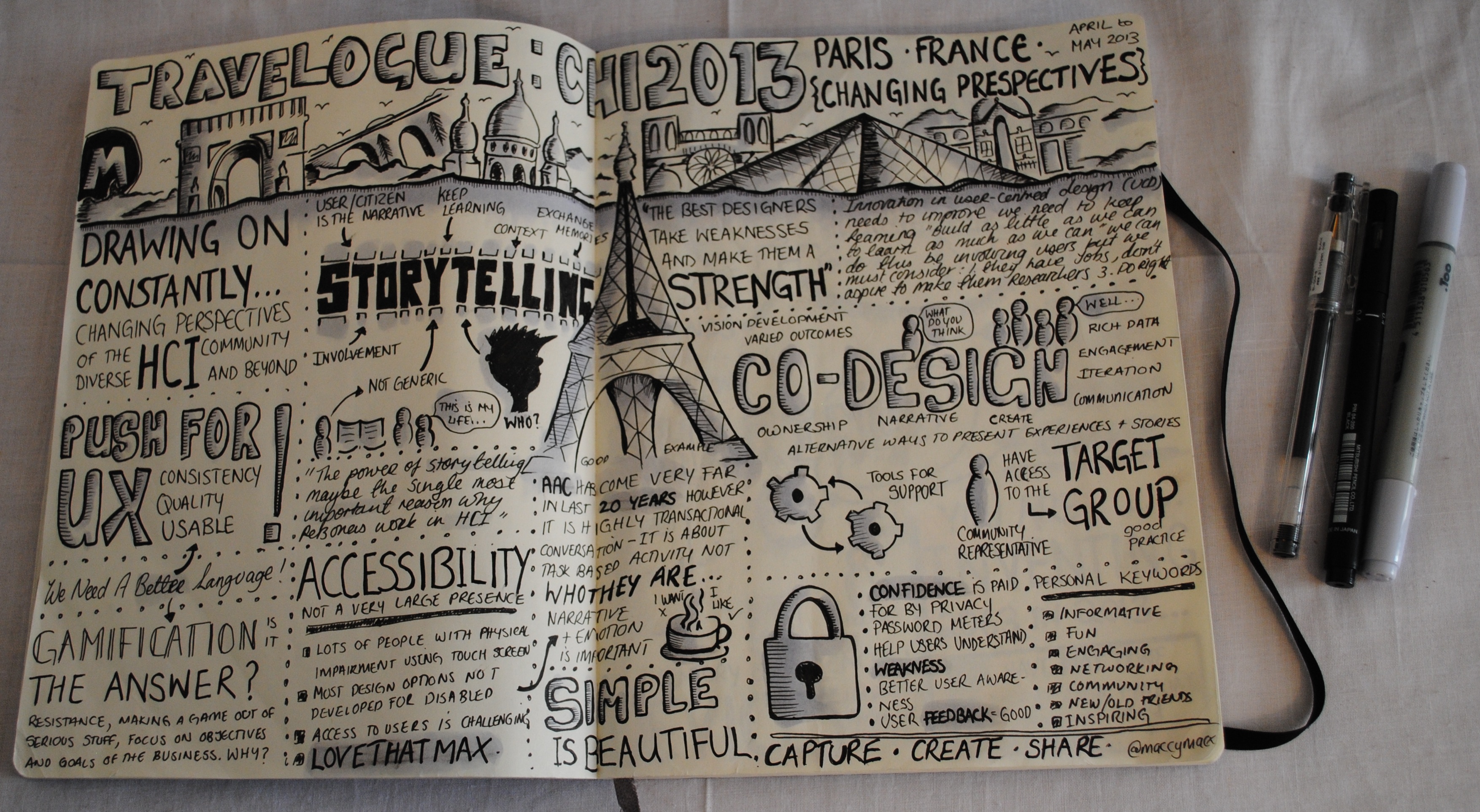
I deleted the post, closed my laptop, opened my Moleskine, grabbed 3 pens and sketched a highlight travelogue that expressed all my key experiences & feelings plus much more.  So here is my “sketch-up” for CHI2013:

Sketchnote Travelogue: CHI2013, Paris France
Sketchnote Travelogue for CHI2013

I have also collated my sketchnotes from the twelve CHI2013 sessions I attended, these range from UX, accessibility, co-design to information security:

My CHI2013 travelogue & session sketchnotes can also be found on Flickr: http://www.flickr.com/photos/makaylalewis/sets/72157633362234865/detail/

©ALL RIGHTS RESERVED.

These photographs are presented here for viewing purposes ONLY. They are NOT royalty free images and may not be used for commercial or private use. Any such use of these images is strictly prohibited. Specifically, these images may not be copied, manipulated, be reproduced by any other means nor sold without prior written consent by the author.